
COLORADO
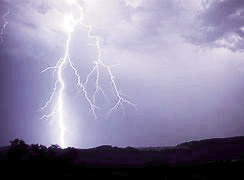
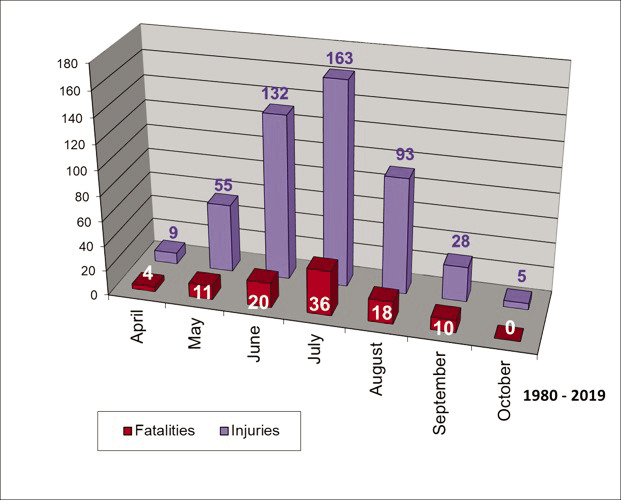
Coloradoans love to spend their summer months outside. But, like most of Colorado's weather, summer weather can change in just a few minutes. Data from the National Weather Service (NWS) from 1980 to 2019 shows that July is the most dangerous month in Colorado for lightning strikes.
Colorado gets zapped by many lightning strikes every year and, while most do not involve people, lightning does kill two to three people and injures about twelve people every summer. Most fatalities occur from June through August, on the weekends, and in the afternoon. The highest risk of lightning strikes tends to be in elevated areas, often near a summit or ridgeline. Lightning is generally less frequent across valleys or parks.
Lightning has been responsible for hundreds of injuries and at least 99 deaths in Colorado since 1980, according to NWS reports. In the years 2008 to 2018, Colorado was tied for 7th in the nation when it came to lightning fatalities. In a longer period of time, years 1959 to 2019, Colorado ranked 4th in the nation for fatalities.
An average of 500,000 lightning flashes hit the ground in Colorado every year, making it ranked 19th in the country in the number of 'Cloud-to-Ground' (CG) lightning flashes. One of the most lightning-prone spots in Colorado is the Palmer Divide between Denver and Colorado Springs, with El Paso County being the most common county for lightning strike casualties in the state.
Lightning strikes are also credited for causing around half of Colorado's wildfires each year.
Lightning strikes can be unavoidable and unpredictable. 'Because lightning is one of the most capricious and unpredictable characteristics of a thunderstorm, no one can guarantee an individual or group absolute protection from it,' the National Oceanic and Atmospheric Administration (NOAA) website reads.
However, it is possible to reduce your risk of being struck by lightning. Plan to start your hikes early in the morning to avoid afternoon thunderstorms. If camping, hiking, etc., avoid open fields, the top of a hill, or a ridge top. Keep your site away from tall, isolated trees or other tall objects. If you are in a forest, stay near a lower stand of trees.
If you are camping in an open area, set up camp in a valley, ravine, or other low area. A tent offers no protection from lightning. If you are camping and your vehicle is nearby, run to it Always monitor the weather forecast and be prepared to turn around if the weather turns. If you hear thunder or see lightning, immediately seek shelter but do not seek shelter under picnic shelters, sports dugouts, porches, trees, carports, rocks, or tents. Remain in a safe location or indoors until 30 minutes after you hear the last clap of thunder.