
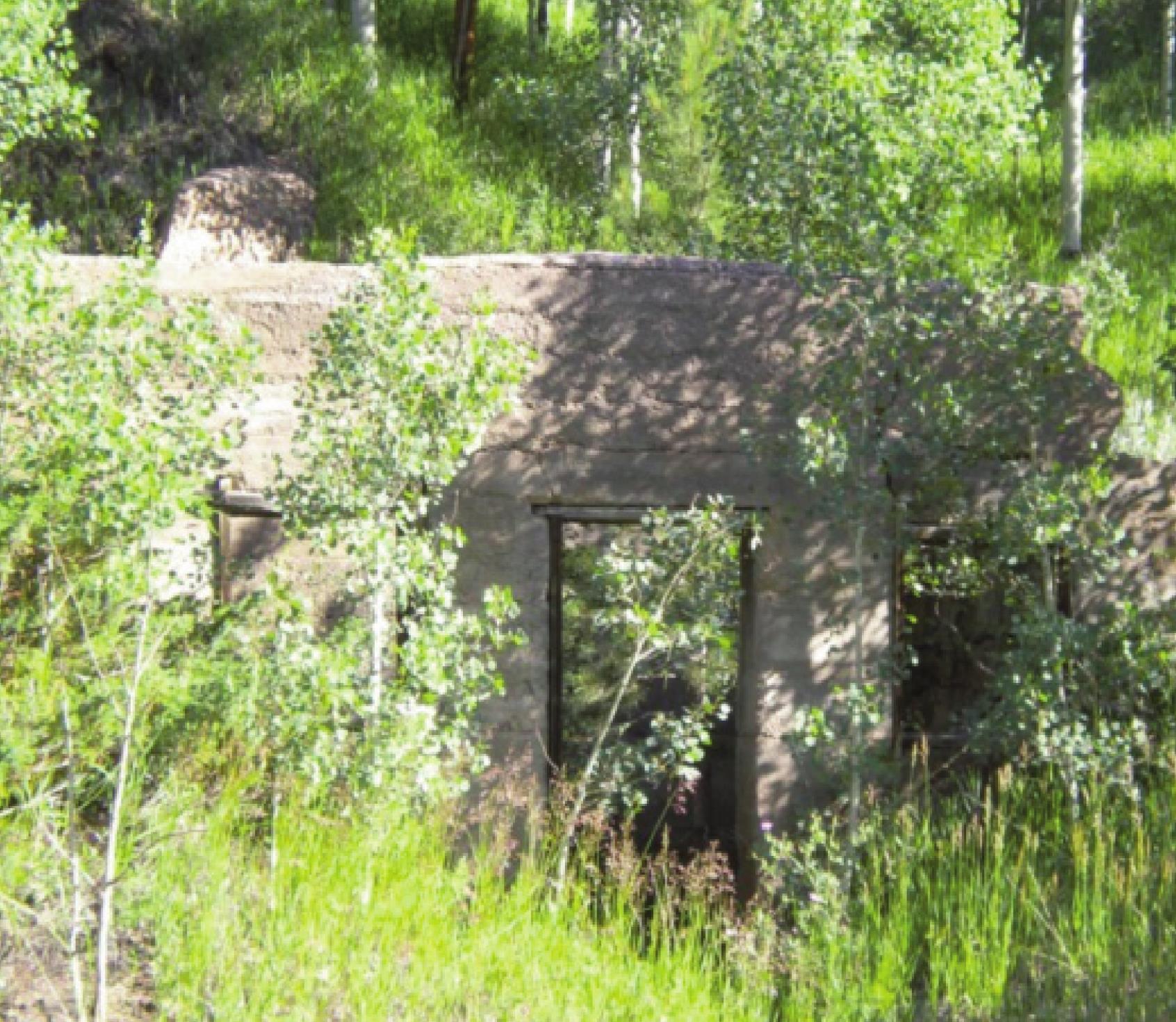
As the legend is told, Juan Maces’ watchmen used Signal Mountain east of Beulah as a lookout point. “When intruders were spotted, Juan Mace would round up his ‘bootie’ and go to ‘Second Mace's Hole’. The entrance to this second valley was very narrow and easy to guard. It was considered too dangerous to enter.”
The Confederate soldiers also, used Signal Mountain as a lookout, but there is no record of them escaping into Second Mace. Regardless, Second Mace, the higher mountain valley to the west, remained closely related to the Beulah area “both in sentiment and by use of the Mace Trail” (later Squirrel Creek Road, now Squirrel Creek Trail).
In the 1880’s, as later homesteaders were forced into the foothills and mountains to find suitable land, settlers found the ‘Second Mace’ Valley. Others moved up into the surrounding hills to hunt for gold.
James H. Clarkson built a home in the Second Mace Valley in 1880. For a short period of time the area was called ‘Clarkson’. This property is located at the southern end of the valley at the hairpin turn on Highway 165, just north of Bishop Castle. Later a hotel was built and operated by the Clarkson family.
Fairview/Forestdale
In 1882, the Fairview Post Office was established, on the Clarkson’s property. The settlers selected the name as they “thought the site offered a ‘fair view’”. The Sierra Journal was much more eloquent in 1884: “The valleys are the most fertile, the hills richer and fairer in herbage and floral verdant, and the forest the grandest and most extensive, the streams the finest and whose pure, limpid waters are fit for the quenching of the Gods.” Even so, many still prefer the name, Second Mace.
The Fairview Post Office served the area from what is now Bigelow Divide to San Isabel City and the mining areas located further to the west. This high and often narrow valley was isolated with access over the divide to Florence or east on what became Squirrel Creek Road to Beulah. The northern end of this elongated valley supported families that farmed, ranched or provided lumber to many of the surrounding areas. The southern end was primarily devoted to mining activities.
Zina H. Fairchild was one of the first settlers near San Isabel involved with prospecting. He founded the Greenhorn Mine which later became the Marion Mine. A report in the Pueblo Chieftain on December 13, 1882 lists the following other prospectors: Ham Davis and (George) Pritchard; Peterson with the Good Enough Mine and T.H. Clements and Smith the Golden Head Mine. The article also reports Fairview (now San Isabel City) has “a store kept by Mr. Smith where all the necessities of life can be had for Pueblo prices, freight added.” Other sources refer to R.F. Smith.
Clara Baum Reed Smith is listed as a widow in Fairview and the mother-in-law of Jason Edwin Dunkle in 1900. [Clara is also listed as widow in 1880 in Pennsylvania, so she was not related to the Mr. Smith that owned the store.] Jason Dunkle purchased part of the Zina Holdred Fairchild homestead near what is now San Isabel in 1897. In November of 1900, Jason sold this land to James M. Hardin and moved with his wife, Anna Marjorie Reed Hull to Washington State where he was awarded a homestead in 1913.
(to be continued)