
Fairview Post Office 1882- 1913
Forestdale Post Office 1914-1926
The tiny community of what most people today call Fairview began its history as Second Mace. It was then linked to what is now Beulah, as it was for much of its early history before Colorado Highway 165 made it accessible to Rye.
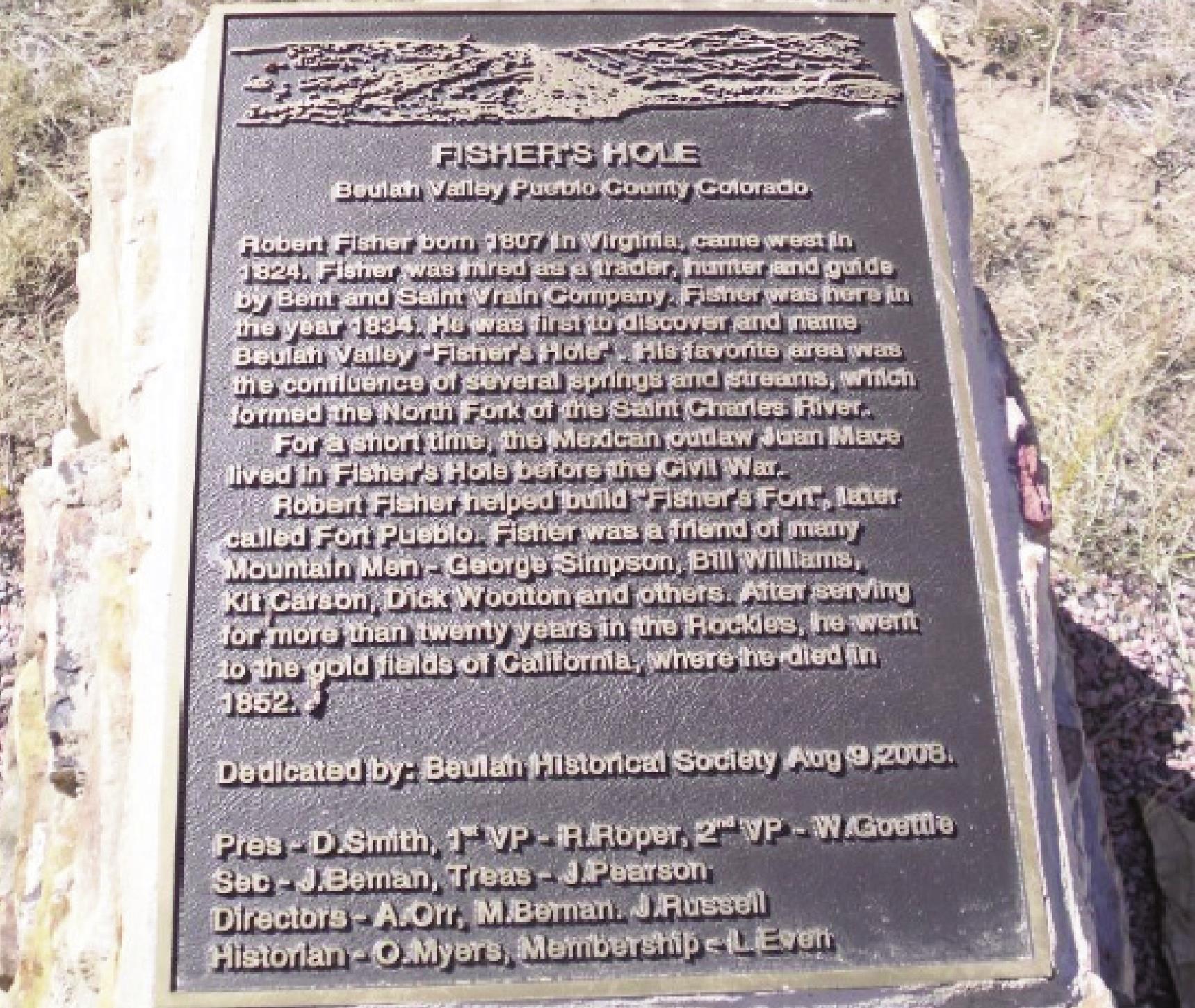
Fisher’s and Mace’s Hole
The Beulah Valley was discovered in 1834 by Robert Fisher, a fur trader, hunter and guide who often worked for Bent, St. Vrain and Company. In 1842, Rufus Sage, a former newspaper reporter who passed through what was to become Pueblo County in the fall of 1842, described Fisher’s Hole, then a part of Mexico, in his journal. “Near the head of the river (the St. Charles or Carlos) is a broad area, known as Fisher’s Hole bounded upon all sides by rugged hills and mountains inaccessible except by a circuitous pass leading into it from the south.”
About 1850, after Fisher’s departure to California, the Beulah Valley took on a new name. A Mexican outlaw, horse thief and cattle rustler, Juan Mace began to use the valley as a hide-out. The area became Mace's Hole or First Mace. During the next twenty years or so countless tales were circulated about a mysterious desperado name Mace, Masa, Maes, Maez or Mez. The name “Mace” was the one most used locally. “Masa’s Hole” was how it appeared on an 1851 map of the New Mexico Territory.
Mace allegedly stole stock from wagon trains or from cattle herds on the open range and hid them in the valley. In 1877, a Pueblo Chieftain contributor described the situation: “there was but one pass into the valley, and that a difficult one. Other passes entered the valley from parks further back and were more difficult to enter and exit. While he (Mace) operated with but a single assistant, losers of stock for years did not dare enter the valley through the solitary, rocky and precipitous pass, because they supposed that a large band of outlaws, armed well and reckless, would annihilate them.”
This belief was reinforced by letters allegedly left by Mace in obvious places on the plains, translated from poor Spanish: “Rock Creek, April 14, 1859. Tom: get three hundred of the boys in fighting order, and have them ready to come and well mounted by the 20th, when we can make a big haul. I hear there is a good many wagon trains, and a lot of chuck coming over this plains. How are the boys? Stay in camp and be handy. By Juan Mace”
Certain other old timers maintained that Juan Mace had herded stock in the valley legally, wintering them for a fee for hunters, traders and freighters. No one knows for sure what happened to Juan Mace, and there are no official records of him or his sons.
Whatever happened, he had vacated the area by 1864, when Colonel John Heffiner used the valley as a rendezvous point for Confederate sympathizers who were trying to organize a regiment to fight in the Civil War. The United States Army got wind of it, soldiers were sent out to scour the area; the Confederates scattered.
Later, Charles Goodnight used Mace’s Hole as a horse ranch. “William Calvert was his horse manager. They had a barrier across the entrance to the valley and were the sole possessors at one time.”
As homesteaders arrived and claimed land in the valley they accepted the name Mace’s Hole for their first post office, which operated from 1873 to 1876. The citizens later voted to change the community’s name to Beulah.
(to be continued)